

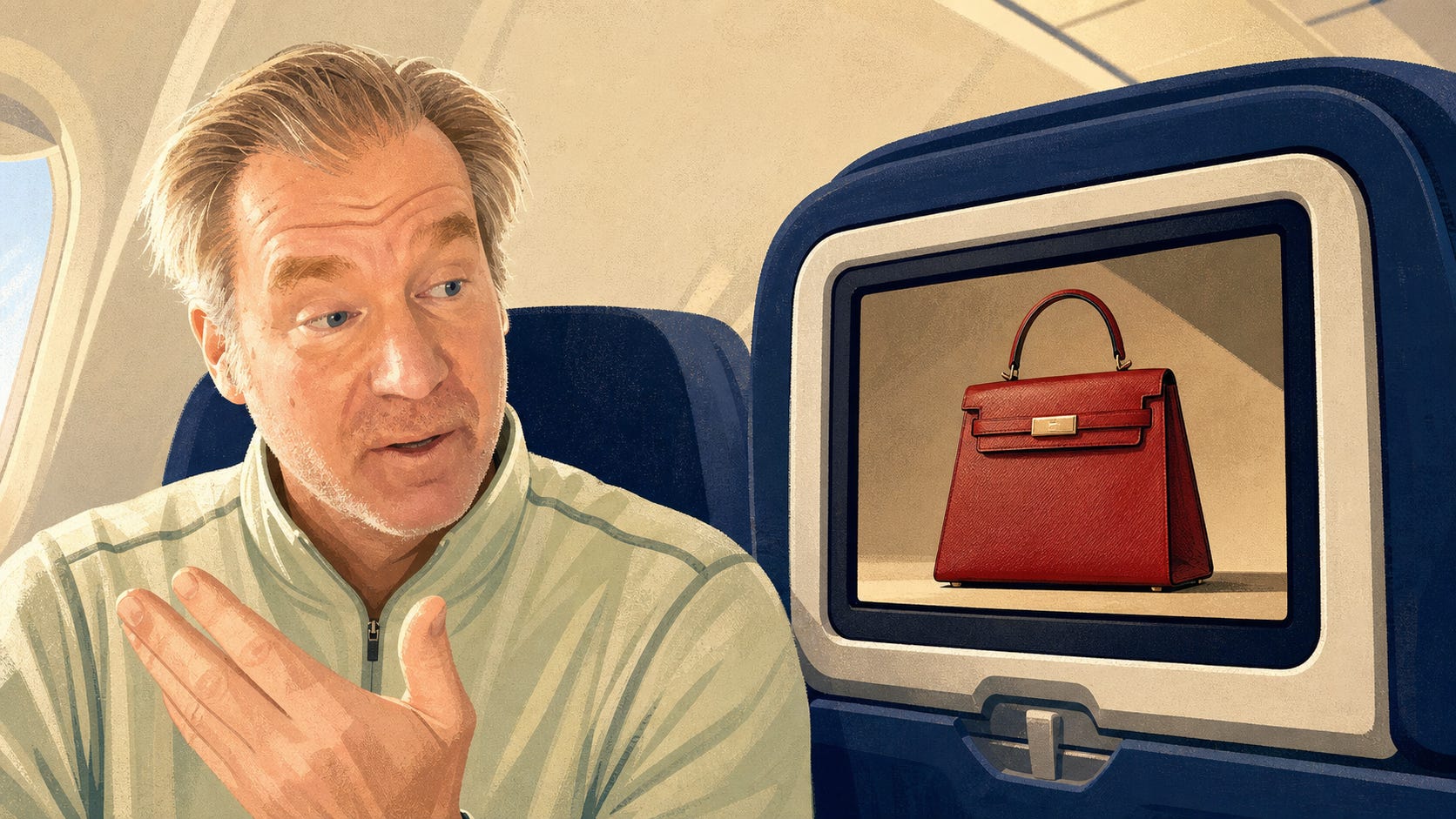
To tell you the truth, I was lowkenuinely (low-key, genuinely) going to just delete the segment Todd had on defining Commerce Media from the recent episode with Collin Colburn of the IAB. I was sitting there editing and I heard Todd say:
I think we'd say that United and the back of the screen or Delta's back of the chair screen is commerce media because…it's not their cart, but their retail media might be if I was showing ads in the checkout of the plane ticket.
I viscerally reacted to this comment. Why the fascination with the cart? My experience with retail media started with Offsite for retailers who hadn’t even fully committed to eCommerce. More to the point, Todd and I had just sat on the Kroger rooftop in Cannes with Christine Foster talking about how a consumer could be targeted on TikTok using the retailer’s audience, but that the cart is basically irrelevant on social for low priced products. Shipping a single can of Poppi because you discovered it on TikTok is absurd. Instead, you’ll discover on social and then buy in-store. In this case the ad exposure was on TikTok, but Kroger was the merchant of record.
Todd and I used to argue a lot, but it was usually because we were both trying to explain the differences between the retail and media worlds. So I kept thinking about what was behind his definition—and whether it could lead us to a better one.
What I think might have been missing from our discourse was a very specific retailer vocabulary word: assortment. A retailer’s assortment is the complete set of products it chooses to sell. Broader Commerce Media networks can create demand for products and services outside their own assortments.
A year ago, we had Harsh Jiandani on the podcast, and he gave us a simple definition of Commerce Media that was easy to remember:
“For me is Retail Media is SKUs and Commerce Media is everything that’s not SKUs. Period.”
In many Retail Media systems, the SKU is more than the final record of what someone purchased. It is the targeting language itself. Customers can become collections of product views, purchases and affinities that determine which products should be promoted to them next.
Harsh later in the episode explained why moving from keywords to SKUs was an operational advance. It gives the system greater precision about what is being advertised and ultimately purchased.
That makes the SKU a useful way to operate retail media, but not a definition of it. SKUs identify the products involved. Shopper missions explain what the person is trying to accomplish.
That distinction matters across Commerce Media. Every network is trying to understand a mission. What changes is whether it owns the advertised assortment. Retail Media networks are generally organized around the retailer’s assortment. Emerging Commerce Media networks can create demand for products and services outside their own assortments.
Travel is my favorite demonstration of why the shopper mission creates value even when the network doesn’t own the advertised assortment.
So when Todd talked about the airline seatback screen he was evaluating its function as a non-transactional surface, and which advertisers can fit. If you’ve heard Todd recently on the podcast he likes to think deeply about how ‘endemic’ the advertiser is to the retailer.
The seatback screen and hotel-room TV are not offsite media. They are owned and operated by the Commerce Media network. What the network may not own is the advertised offering. You’re not buying another airline ticket or hotel room. You’re deciding what else you want from the trip, often on impulse.
Impulse in grocery might mean grabbing M&M’s at checkout. Travel changes the scale. Once someone has paid for the flight and hotel, the impulse purchase might be a handbag, an expensive dinner or an excursion. Those purchases can feel justified because they help the traveler make the most of what they have already spent, and therefore…live the version of the trip they truly imagined.
In a recent two-part study conducted by BCG and commissioned by Kinective by United and Marriott Media, we see that travel purchases cover a whole range of categories. It would actually be inefficient for the Commerce Media network to ‘stock’ all of these SKUs and experiences.
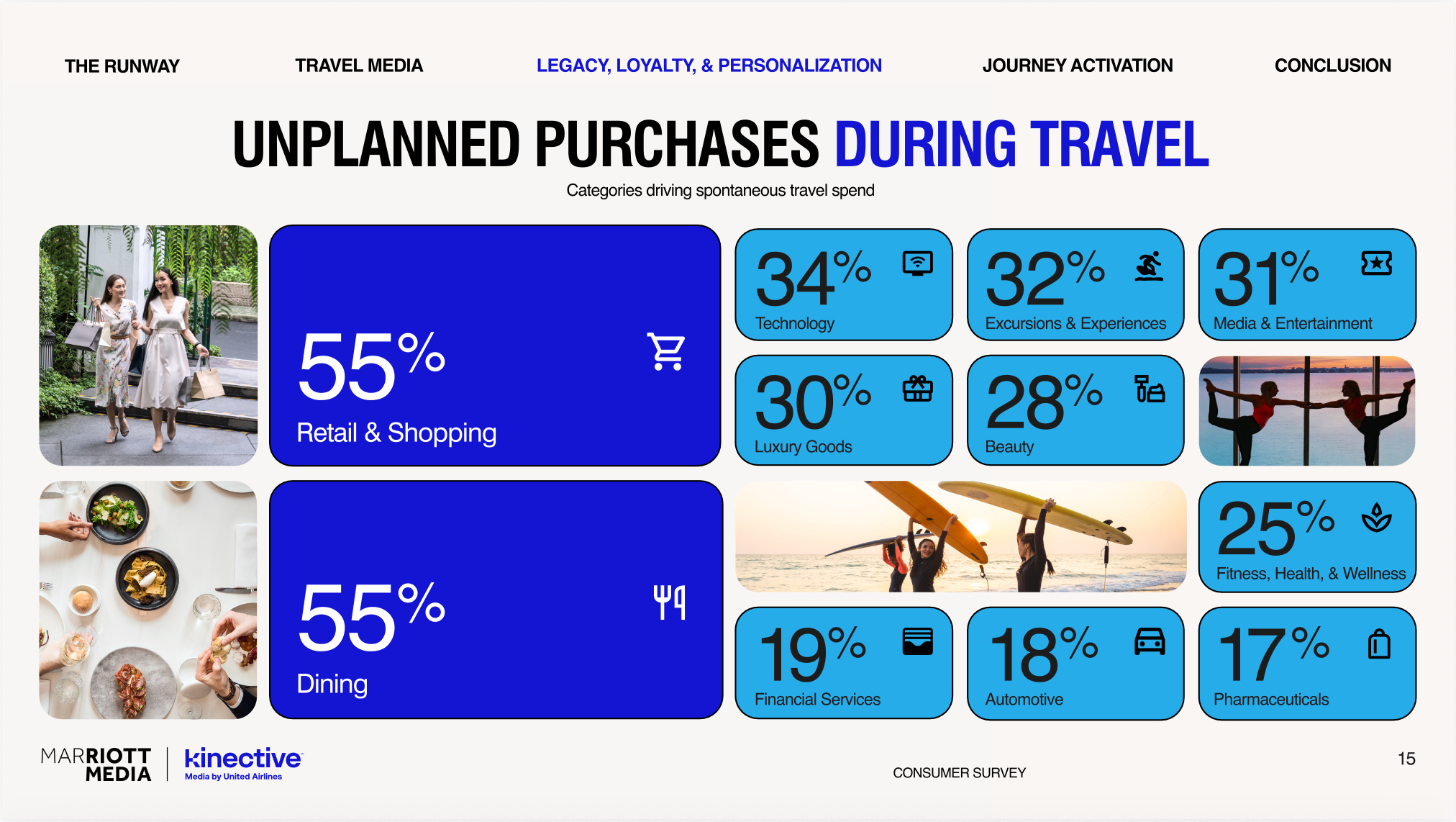
“Installment II: Tapping into the Psychology of Travel.” Consumer survey conducted by BCG, Powered by Marriott Bonvoy & United Airlines
Not owning the assortment is part of what makes these Commerce Media networks interesting. It is also what makes their measurement more complicated.
The partnership is already happening
Before moving on, it is worth pausing on who sponsored the BCG research.
United and Marriott could each have commissioned research about its own audience. Instead, Kinective Media and Marriott Media studied the traveler together across the journey. They are not combining assortments; they are recognizing a shared mission. The open question is whether that partnership extends to measurement.
If United shows an ad for a hotel, the hotel or OTA records the booking. If Marriott promotes an excursion, the tour operator may become the merchant of record. The network owns the media exposure, but another business owns the resulting transaction.
At the end of our conversation with Collin Colburn, he acknowledged that retailers are not incentivized to standardize their measurement. His more practical proposal is disclosure: explain the attribution windows, ROAS methodology and incrementality approach so advertisers can interpret the results themselves.
Travel Media adds an earlier question. Before advertisers can compare methodologies, does the outcome even make it back to the network that influenced it?
A better definition—and the next questions
After mulling over the seatback screen, carts, SKUs and assortments, I think we have arrived at something more useful:
A Commerce Media network turns a first-party commercial relationship into media by using what it knows about a customer’s mission to create demand for products and services, whether they are in its own assortment or offered by merchant partners.
Retail Media fits within that definition, but it is generally organized around the retailer’s own assortment. Kroger can reach someone on TikTok, promote a product it carries and record the eventual in-store purchase.
Travel Media shows us the broader model. A network can understand the mission and own the moment of attention without fulfilling every need or recording every transaction.
That gives us the next set of questions for Shopper Missions. What does each network know about the mission? Who fulfills the resulting demand? Does the transaction return to the network that influenced it? If several networks participate, does anyone receive an assist?
Those are the conversations we now want to have with travel, financial-services and mobility networks. Commerce Media gets interesting when one business understands the mission and owns the moment of attention, while another owns the assortment and records the transaction. Will they all play nicely?
Appreciate your thought provoking writing here on Shopper Missions as well as the podcast. Jotted down some notes as I was reading your "Retail Media isn't a Cart. Commerce Media can't mean Everything." Substack article. Fun as we all learn together and open to your thoughts if you want!
Article quoted then my thoughts format:
“Shopper missions explain what the person is trying to accomplish.”- How would this work for TikTok Shop advertising or any Social Commerce advertising as the mission is scrolling, but becomes shopping IF something catches their eye. Also same concept for LLMs as wide range of what the original mission was for people using them (granted shopping and research of products is a mission type here). The original line in from your article is in quotes and then my thoughts inspired by you.
“A Commerce Media network turns a first-party commercial relationship into media by using what it knows about a customer’s mission to create demand for products and services, whether they are in its own assortment or offered by merchant partners.”- Is all, some, or none of digital OOH advertising part of Commerce Media?
“Retail Media fits within that definition, but it is generally organized around the retailer’s own assortment. Kroger can reach someone on TikTok, promote a product it carries and record the eventual in-store purchase.” Does it make it messier to factor in the online assortment of Retailers for the SKU portion of this? Even messier if you consider not just the 1P Vendor retailer online site, but also if they would/should include products on their 3P Marketplace if they have one?
“Does the transaction return to the network that influenced it? If several networks participate, does anyone receive an assist?” The other fun part of this situation is how do Brands decide whose budget this comes out of and how does the MMM or any measurement provider track it (I do like Clerdata’s approach and capabilities)
“Broader Commerce Media networks can create demand for products and services outside their own assortments.”- Isn’t this considered Non-Endemic Advertising which Kiri brought to more attention in her Amazon for CMOs book before Covid! I know the original Todd will debate this! Maybe this would be a good industry panel debate between Kiri vs Collin/Todd S.
Also would we look at Coca-Cola and PepsiCo ads on a United Airlines flight differently in terms what kind of media since a traveler could get a Coca-Cola product on that United flight, but not the PepsiCo one….unless they used their T-Mobile free Wi-Fi to order it on Gopuff for delivery to their hotel when they land. Would PepsiCo invest in United Airlines ads considering their partnership with competitor and/or could United Airlines accept the ad from PepsiCo. I digress, but fun to consider with a hint of reality.